Introduction: The Key to Greatness is Simplicity
In a time when energy prices are going up and climate goals are essential, we can’t just build new buildings; we have to build smart ones. There isn’t just one technology that will help you design buildings that use less energy. Instead, there is a rational, five-step method that puts performance and simplicity ahead of complexity.
These five phases are the core blueprint for architects, engineers, developers, and homeowners who want to go beyond just following the code. By starting with the biggest energy users—the basics—you can develop a strong, pleasant, and long-lasting building that saves money and has a small carbon impact for many years to come.

Step 1: Use Passive Design Strategies To Make The Site A Priority
Using the site’s free energy is the first and most important step in creating a building that uses less energy. Passive design is the art of this.
A normal building battles the weather, but a smart building works with it. This entails looking closely at the local microclimate, such as the routes of the sun, the direction of the wind, and the things that shade the area.
Orientation and Massing
Start with how the building is facing. In the Northern Hemisphere, putting the long side of the structure East-West lets the most windows face South. This lets in the most useful daylight and winter heat while keeping the East and West façades from being too hot from the low-angle morning and afternoon sun.
You can then use architectural features to manage this solar gain, such as:
- Overhangs and Louvers: Overhangs and louvers are designed to keep out the bright summer heat while letting in the lower winter sun.
- Thermal Mass: Putting heavy materials like concrete or brick on the inside helps soak up extra heat during the day and slowly release it when the temperature drops. This keeps the temperature inside from changing too much.
Getting the orientation correct cuts down on the energy needed for lighting, heating, and cooling by a huge amount before any mechanical system even goes on.

Step 2: Make A Perfect, High-Performance Envelope
Step 1 is about using the sun and wind intelligently, and Step 2 is about making a great envelope, which is the outside layer that keeps the inside safe from the weather. The envelope (walls, roof, floor, and windows) is the most important part of a building that affects how much energy it uses.
Three main parts make up a high-performance envelope:
Super Insulation and No Air Leaks
The base is quite well insulated. This implies using insulation with high R-values (thermal resistance) in the walls, roof, and foundation. It should also be continuous so that there are no thermal bridges (places where heat may easily escape).
It is also very crucial to be airtight. Uncontrolled air leaks, or draughts, can cause a traditional building to lose up to 50% of its energy. To get a fully airtight seal, you need to pay close attention to the details, use high-quality membranes, and use specific tapes around every joint and penetration. A blower door test is typically used during construction to check this. What happened? A steady, comfortable temperature inside with little heat loss.
High-Performance Glazing
Windows are usually the weakest part, but contemporary high-performance glazing turns them into energy assets. Check for:
- Double Or Triple Glazing: It means that there are two or three panes of glass separated by an inert gas, like argon, to keep the heat in.
- Low-E (Low-Emissivity) Coatings: These tiny coatings let visible light through but deflect infrared (heat) radiation. This keeps heat in during the winter and out during the summer.

Step 3: Choose Systems That Are Simple and Very Effective
You can choose the mechanical and electrical systems once the passive design (Step 1) and the high-performance envelope (Step 2) have made the requirement for heating and cooling much less. You can choose smaller, simpler, and far more efficient equipment because the loads are small.
The HVAC Revolution
Forget about big furnaces and regular air conditioners. The systems that work well currently are:
- Heat Pumps: Heat pumps move heat instead of creating it, which makes them three to five times more efficient than heating systems that use fossil fuels. They may heat and cool at the same time.
- Mechanical Ventilation with Heat/Energy Recovery (MVHR/ERV) is necessary in buildings that are airtight. These units constantly bring in fresh, filtered air and recover up to 90% of the energy from the stale air that leaves, which cuts down on heat loss through ventilation by a huge amount.
- LED Lighting: Only use LEDs. They use less energy than older bulbs, last longer, and give off less waste heat, which lowers the cooling load.

Step 4: Use Smart Technology to Combine and Improve
A smart brain is needed for a smart building. Step 4 is about using Smart Building Technology to make sure that the very efficient systems are working at their best every day, not only on paper.
The Internet of Things (IoT) powers the Building Management System (BMS), which is the main technology here. Sensors put all throughout the building collect information on the temperature, humidity, number of people in the building, and the amount of light.
The BMS can do the following with this real-time data:
- Adaptive Control: Change the lighting settings based on how much natural light is available, or make small changes to the HVAC setpoint in a room that isn’t being used.
- Predictive Maintenance: Keep an eye on how well the system is working to find flaws or inefficiencies before they become expensive issues.
This layer of intelligence makes sure that no energy is ever lost because of human error or settings that aren’t quite right. It also makes sure that the building works exactly as the designer planned.

Step 5: Use Renewable Energy Sources and Do a Life-Cycle Analysis
The last stage looks at the building’s total environmental impact and the energy demand that is still there. After Steps 1–4 have cut down on energy use as much as possible, on-site renewable energy can make up for the rest of the load.
Achieving Net-Zero
The most typical answer is to use Solar Photovoltaics (PV). Strategically placed solar panels can provide enough clean power to meet the building’s yearly energy needs, turning it into a Net-Zero Energy Building (NZEB). A low-energy structure needs a lot fewer panels, which makes the investment very cost-effective.
In addition to operational energy, a great design also takes into account embodied carbon, which is the greenhouse gasses that are released when building materials are made, moved, and put together. This is where Life-Cycle Analysis (LCA) comes in.
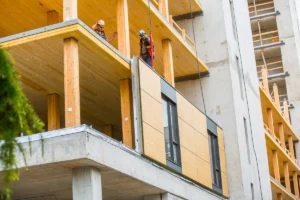
- LCA: This modeling technique helps designers choose materials with low embodied carbon, like mass lumber or recycled steel, to reduce the environmental impact from “cradle to grave.”

You don’t just design a building that works; you design a beautiful, high-performing asset that respects the earth and the business line by mastering these five processes, from passive orientation to full integration of renewables.
For more blogs like this CLICK HERE!!
Reference:
Designing a Zero-Energy Building: A Step-by-Step Guide – Green Building Solutions
Energy-Efficient Building Design Guide 2025