Introduction & Core Philosophy
What if buildings could evolve like organisms — adapting, flowing, and responding to their environment through pure mathematical logic?
That vision gave birth to Parametricism,
one of the most influential architectural movements of the 21st century.
Coined and championed by Patrik Schumacher of Zaha Hadid Architects, Parametricism emerged as the natural successor to modernism and deconstructivism — but with a digital soul.
Where modernism prized simplicity and function, and deconstructivism celebrated chaos and fragmentation, Parametricism introduces a new kind of order — one governed by algorithms, relationships, and continuous variation.
At its core, Parametricism is about designing with parameters — variables that define geometry, form, and structure.
Instead of manually drawing each line, the architect sets rules and relationships in digital software, and the form grows organically from those constraints.
It’s a design philosophy rooted in computation, fluidity, and interconnectivity.
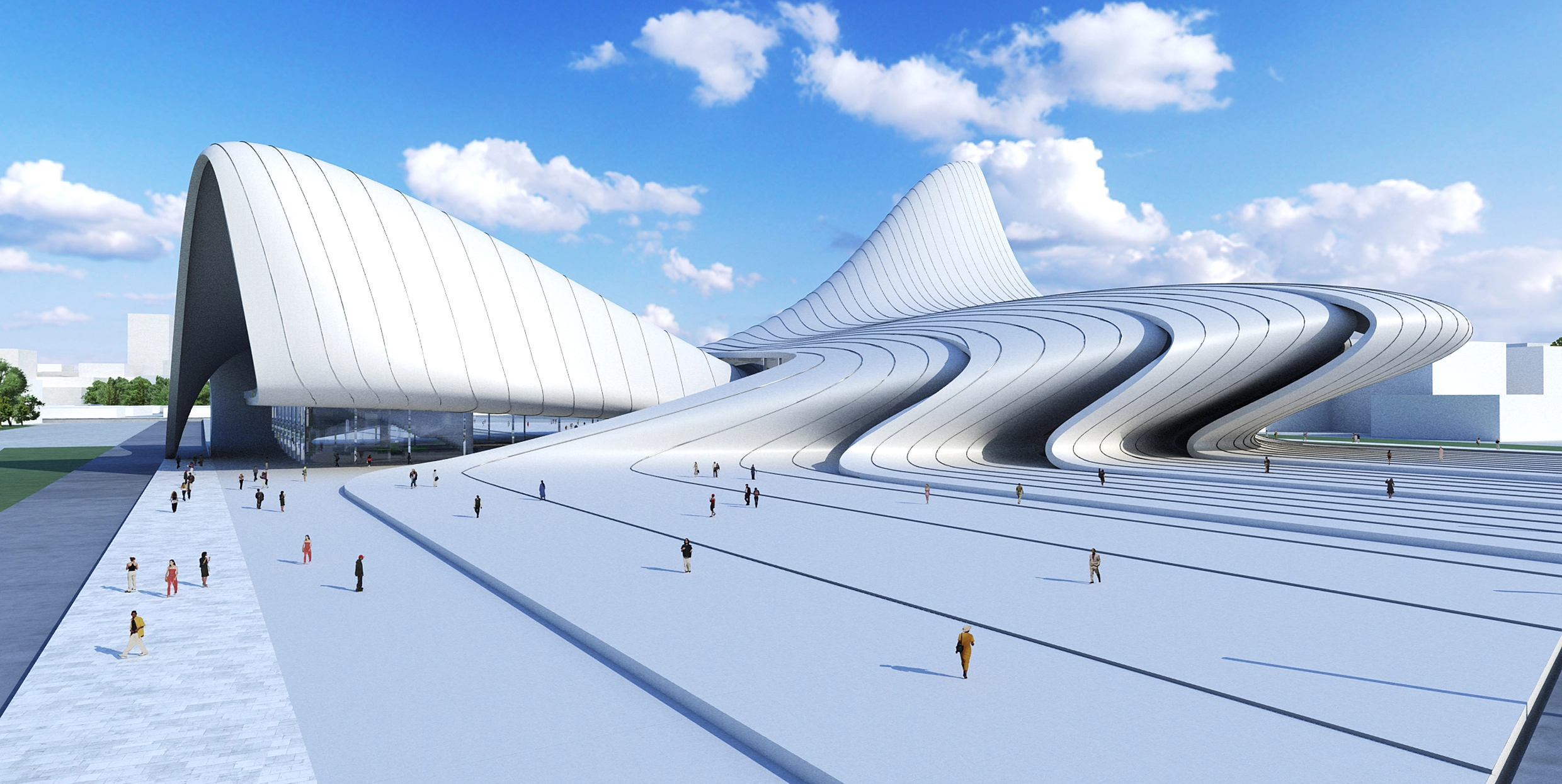
Parametricism doesn’t imitate nature — it operates like it, producing organic, fluid, and futuristic forms that feel alive, responsive, and in constant motion.

Key Architectural Features of Parametricism:
To design in this style, it’s important to understand the core features that define its aesthetic and logic.
- Algorithmic Form Generation:
Parametricism is powered by data.
Every curve, surface, and connection is generated through algorithmic relationships — not arbitrary lines.
This allows architects to manipulate shape, structure, and performance with mathematical precision.
Form becomes the result of process — a direct expression of the system behind it. - Fluid, Continuous Surfaces:
Forget corners and flat planes.
Parametric architecture thrives on smooth, flowing transitions between walls, ceilings, and floors.
Spaces merge seamlessly, creating a sense of movement and coherence — a continuous spatial experience that mirrors natural forms like waves, dunes, or bone structures. - Responsive and Adaptive Design Logic:
One of the key powers of Parametricism is its ability to respond to external inputs — sun angles, wind flow, human movement, or acoustic data.
Through computational modeling, the design adapts to these parameters in real time, allowing architecture to become performative and context-aware. - Complex Geometries Made Constructible:
Thanks to digital fabrication and advanced modeling tools like Grasshopper, Rhino, and Maya, complex geometries once impossible to build are now achievable.
These tools allow precise control over curvature, structure, and material performance — translating organic design directly into fabrication data. - Hierarchical Variation and Systemic Order:
Parametricism isn’t random. It’s governed by a systemic coherence — where every component is related through scale and pattern.
Elements vary continuously but remain part of a larger logic.
This creates visual unity across highly complex compositions — an ordered complexity that feels both futuristic and natural. - Integration of Structure and Skin:
In traditional design, structure and façade are separate entities.
In Parametricism, they merge into one integrated system, often with structural ribs or exoskeletons following the flow of the surface.
This creates expressive architecture where the skeleton and skin speak the same design language. - Futuristic and Organic Aesthetic;
Parametricism’s aesthetic is unmistakable — fluid, organic, and dynamic.
It rejects repetition and static symmetry, embracing continuous morphing forms that seem to move even when still.
These designs often evoke a sense of future — not through ornament, but through computational purity.
Notable Examples of Parametricism:
Parametricism has shaped some of the most iconic and influential architectural works of our time.
The Beijing Daxing International Airport, designed by Zaha Hadid Architects and ADP Ingeniérie, translates parametric principles into a massive scale, organizing circulation, light, and form through algorithmic flow.
The Yas Hotel in Abu Dhabi by Asymptote Architecture demonstrates how a dynamic façade — driven by digital modeling — can produce both beauty and performance, using a fluid shell of steel and glass that wraps around two towers and a racetrack.
And UNStudio’s Mercedes-Benz Museum in Stuttgart reveals how parametric logic can inform spatial sequencing — spiraling ramps and voids derived from circulation algorithms rather than intuition alone.
Each of these buildings demonstrates how computation enables architecture to become a living system, where every element has a reason, a rule, and a relationship.

UNStudio’s Mercedes-Benz Museum in Stuttgart/ Credit: Eva Bloem
How Parametricism is Affecting Architecture Today:
Parametricism didn’t just change how buildings look — it changed how architects think.
It replaced static design with process-based thinking, where form emerges from logic rather than artistic impulse.
This shift has influenced everything from urban design to furniture — transforming architecture into an evolving ecosystem of data and adaptation.
In practice, Parametricism has led to smarter, more responsive environments.
Architects use algorithms not only to generate form, but to simulate performance — optimizing light, airflow, energy use, and even human experience.
It has also reshaped the aesthetics of the modern city.
Where once we saw repetition and rigidity, we now see fluid skylines, adaptive skins, and continuous morphing geometries that reflect the digital age’s rhythm.
But perhaps most importantly, Parametricism has opened architecture to new collaborations — between designers, coders, engineers, and robotic fabricators.
It’s a truly interdisciplinary movement, where architecture is no longer drawn — it’s computed, grown, and evolved.

AADRL | Patrik Schumacher Studio
Parametricism isn’t just a style — it’s a paradigm shift.
It represents architecture’s transition from mechanical precision to biological intelligence — from fixed form to fluid adaptability.
As we move further into the age of AI, automation, and environmental data, the principles of Parametricism will only deepen:
integration, responsiveness, and continuous transformation.
For more blogs like this CLICK HERE!!
Reference
Parametric Architecture – Innovations in Design and Construction
Parametricism: Shaping the Future of Architecture (1997-Present) – RTF | Rethinking The Future