What if buildings could flow like water, bend like clay, and breathe like living organisms?
That’s the vision behind Blobitecture, one of the most expressive and fluid architectural movements of the late 20th and early 21st centuries.
Emerging in the digital age, Blobitecture — short for “blob architecture” — celebrates smooth, bulging, and organic forms that seem to defy geometry. It’s a design language shaped not by rulers or right angles, but by algorithms, computer modeling, and 3D software that allow architects to sculpt freely in digital space.
The philosophy behind Blobitecture is simple yet revolutionary: form follows emotion, not function. Instead of the rigid structures of modernism or the fragmented chaos of deconstructivism, Blobitecture seeks to capture life and motion — to make architecture appear as if it’s growing, morphing, or even melting.
It’s an art form rooted in digital freedom, made possible through parametric design and computer-aided manufacturing. The architect becomes a sculptor of the virtual — shaping buildings that blur the boundary between nature, technology, and imagination.
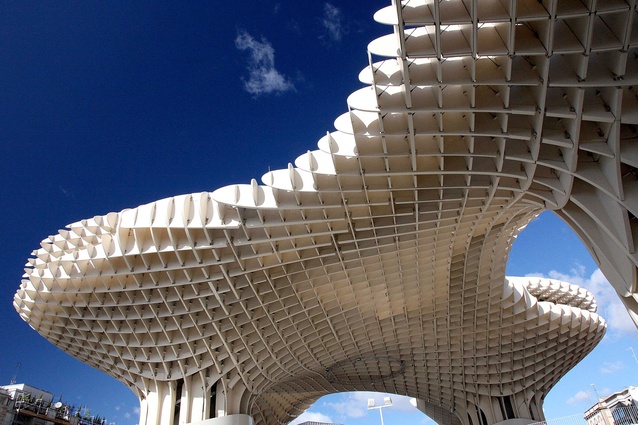
The Metropol Parasol in Seville, Spain, designed by J. Mayer H. Architects was completed in 2011.
Key Architectural Features of Blobitecture
At the heart of Blobitecture are a few defining design elements that every architect or designer should understand if they want to work in this style.
Fluid, Amoeba-Like Forms
Blobitecture rejects the straight line. Buildings take on bulbous, fluid, and biomorphic shapes that feel organic — as if they’ve been shaped by natural forces rather than human hands.
Think of rounded surfaces, flowing transitions, and undulating forms that resemble water droplets, clouds, or even living tissue.
Smooth, Seamless Surfaces
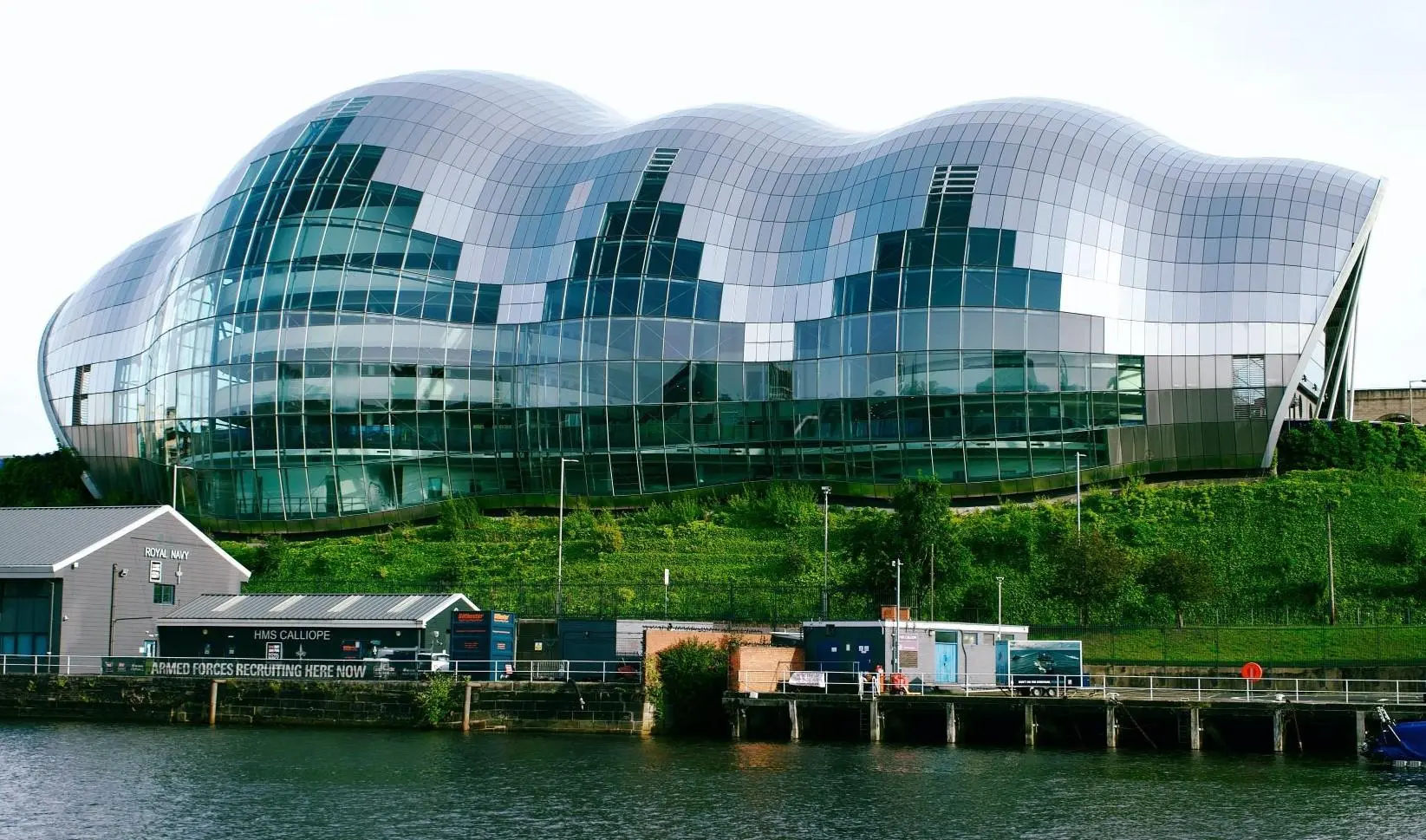
One of the most recognizable features of Blobitecture is its continuous, skin-like surfaces. There are no sharp edges or clear separations between walls, roofs, and floors — everything appears to merge and flow.
These surfaces are often made from glass, steel, or composite materials, giving the building a futuristic, almost liquid sheen.

Experience Music Project, Seattle, Image Darwin Bell
Advanced Digital Modeling and Fabrication
Blobitecture couldn’t exist without technology. Architects rely on parametric modeling, 3D scanning, and computer-aided design (CAD) to manipulate complex curves and surfaces with mathematical precision.
Software like Rhino, Maya, and Grasshopper has turned freeform architecture from a fantasy into an achievable reality.
Structural Innovation Beneath the Surface
Despite their organic appearance, Blobitecture buildings are feats of structural logic. Hidden beneath their curved skins are steel or reinforced concrete skeletons designed to support non-linear forms.
Digital simulation allows architects to calculate load distribution in complex geometries, ensuring that even the most unconventional shapes stand firm.
Light, Reflection, and Transparency
Light plays a central role in Blobitecture. Architects use reflective materials, translucent panels, and dynamic glazing to create buildings that shimmer, shift, and transform with time and weather.
The result is an architecture that feels alive — constantly reacting to its surroundings, much like a living organism adapting to its environment.
Integration of Environment and Emotion
Blobitecture isn’t just about appearance. Its goal is to create sensory experiences — spaces that feel immersive and fluid.
The curved forms soften spatial perception, guiding movement naturally and making visitors feel enclosed in a dynamic, flowing environment.
Notable Examples of Blobitecture
Some of the world’s most daring architectural experiments have been shaped by Blobitecture’s philosophy.
The Selfridges Building in Birmingham, designed by Future Systems, is perhaps the most iconic example. Its smooth, undulating façade covered in thousands of aluminum discs gives it a surreal, futuristic character — part machine, part organism.
Then there’s the Kunsthaus Graz in Austria, often called “The Friendly Alien.” Designed by Peter Cook and Colin Fournier, it features a biomorphic blue exterior that contrasts yet harmonizes with its historic urban surroundings.
Greg Lynn’s Embryological House Project also represents the digital side of Blobitecture — an exploration of how architecture can evolve from computer-generated forms rather than traditional blueprints.
And of course, Jan Kaplický’s designs for buildings like the Media Centre at Lord’s Cricket Ground showcase how technology and creativity merge into an architecture that’s at once functional and poetic.
These examples prove that Blobitecture isn’t just a style — it’s a statement. A statement about freedom, imagination, and the limitless potential of digital design.

How Blobitecture is Affecting Modern Architecture
Blobitecture’s impact goes far beyond a visual trend. It has reshaped how architects think about design, technology, and fabrication.
By breaking away from orthogonal geometry, Blobitecture paved the way for parametricism and algorithmic design, which now dominate contemporary architectural thinking.
What began as a radical experiment in the 1990s is now influencing how cities are being envisioned — from fluid museum forms to adaptive building skins that respond to climate and movement.
Its influence can be seen in the works of Zaha Hadid, UNStudio, and MAD Architects — all of whom use fluid geometry not just for aesthetics, but to communicate motion, energy, and emotion in space.
Blobitecture also redefined how buildings are made. Digital fabrication, CNC milling, and 3D printing — technologies once used in aerospace and automotive industries — are now standard in architectural production, thanks to the groundwork laid by Blobitecture’s pioneers.
In essence, Blobitecture changed architecture’s DNA.
It taught designers that a building doesn’t have to look built — it can look born.
Blobitecture is more than a visual rebellion.
It’s a bridge between art and algorithm, nature and technology, emotion and precision.
It challenges us to see architecture not as a static container for life, but as a living expression of it. This is the architecture of flow — the architecture of tomorrow.
For mor blogs like this CLICK HERE!!
Reference
What is Blobitecture in architecture? (History etc.) – Layak Architect
Blob Architecture Explained: The Future of Organic Design in Urban