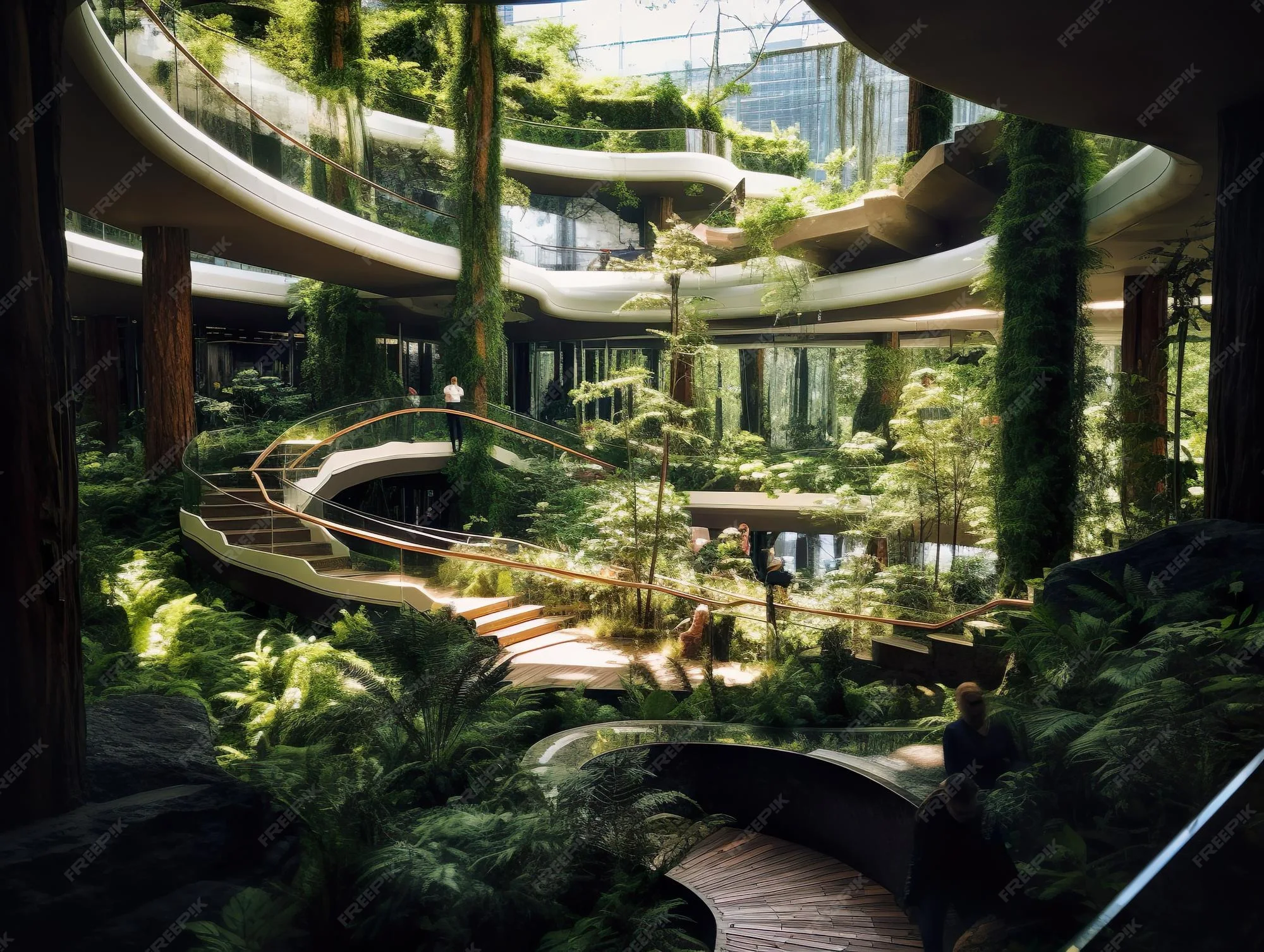
Imagine a building that breathes, that shifts with daylight, that feels alive.
A space that not only shelters you — but restores you.
Welcome to Biophilic Design, a design philosophy rooted in one timeless idea: humans need nature to thrive.
In this blog, we’ll uncover the key characteristics of Biophilic Design, explore how it transforms spaces into living ecosystems, and why it’s becoming the future of architecture.
So, let’s begin with the question — what makes a design truly biophilic?
UNDERSTANDING BIOPHILIC DESIGN
The word biophilia means “love of life.”
Coined by biologist Edward O. Wilson, it describes our instinctive desire to connect with the natural world — with greenery, sunlight, water, and organic forms.
Biophilic Design takes this biological truth and turns it into architecture.
It’s not just about adding plants or open windows.
It’s about designing spaces that reflect the systems and rhythms of nature — spaces that enhance our well-being physically, emotionally, and psychologically.
In essence, Biophilic Design is about rebuilding the bridge between humans and the natural environment.

Fig. 1. Examples of the integration of plants, water or analogous natural forms in architecture [Source: (a) Hanging Garden of Babylon (b) Antoni Gaudí’s Casa Batllo; (c) Le Corbusier’s Immeubles-villas; (d) Frank Lloyd Wright’s Fallingwater]
WHY IT MATTERS
We spend nearly 90% of our lives indoors, surrounded by screens, artificial light, and static air.
This disconnection has measurable effects — fatigue, stress, and declining focus.
Biophilic Design is the antidote.
Research shows that natural light improves mood, greenery lowers blood pressure, and views of nature boost creativity and recovery rates.
Architecture has always shaped behavior.
Biophilic Design takes that power and uses it for restoration — to create buildings that heal instead of harm, that inspire instead of isolate.
THE CHARACTERISTICS OF BIOPHILIC DESIGN
Let’s break down the core characteristics that define Biophilic Design.
Each characteristic is a principle — a design language that translates nature into the built world.
Natural Light and Dynamic Lighting
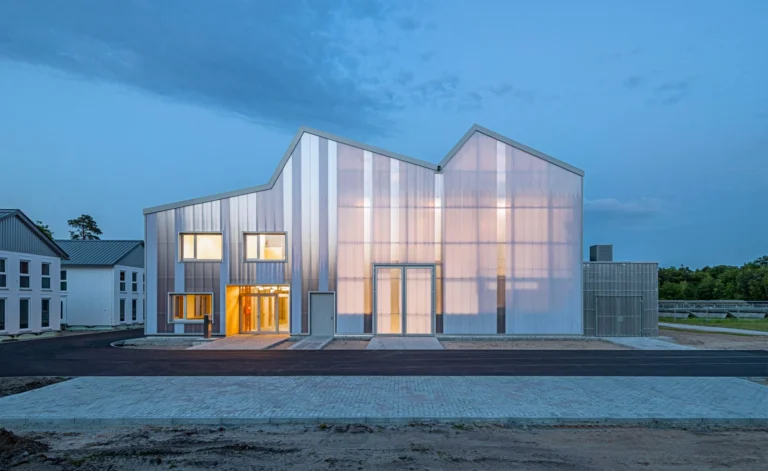
Natural light is the lifeblood of Biophilic spaces.
Designers maximize exposure to daylight using skylights, large windows, clerestories, and light wells — not only to illuminate but to align indoor rhythms with the natural day.
Dynamic lighting — the gradual shift of brightness and shadow — mimics the sun’s movement, enhancing circadian balance and comfort.

Biophilic Design Source: cultivateuae.com
Connection to Natural Systems
Biophilic Design recognizes natural cycles — water, air, and seasonal change — as part of architecture.
Designers use natural ventilation, rainwater systems, and open courtyards that respond to weather.
When you hear the wind through a corridor or feel the temperature shift with the season, you’re experiencing architecture that’s alive.
Use of Natural Materials
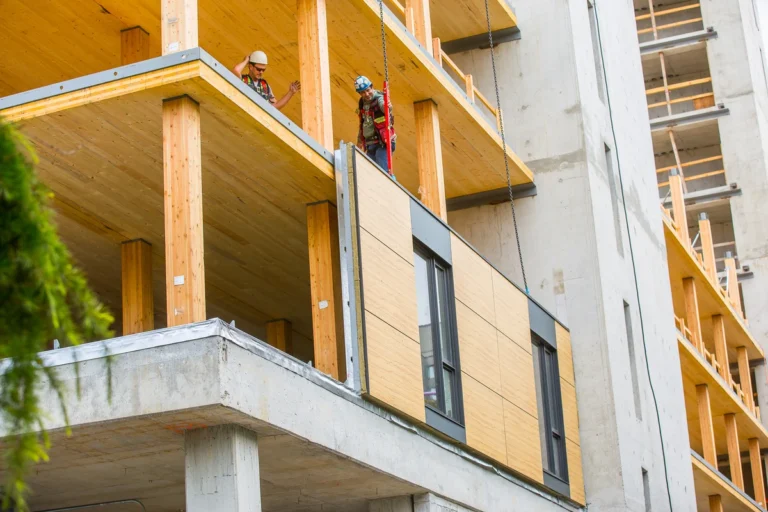
The tactile warmth of wood, the cool solidity of stone, the texture of bamboo — these materials root us in the physical world.
Biophilic Design avoids sterile, synthetic finishes.
Instead, it emphasizes authentic, renewable, and locally sourced materials that age gracefully — echoing the imperfections of nature itself.
Presence of Vegetation and Living Systems
Plants are perhaps the most recognizable element of Biophilic Design.
But it’s not just about aesthetics — greenery plays functional roles: filtering air, regulating temperature, and softening acoustics.
From vertical gardens to green roofs, vegetation blurs the boundary between inside and outside — creating immersive, multisensory environments that pulse with life.
Water Elements
Water is a universal symbol of calm and continuity.
In Biophilic Design, it’s introduced as movement, reflection, and sound.
The gentle sound of trickling water, the glimmer of light on a pool, or the cooling effect of mist — these experiences soothe the mind and connect people to natural rhythms.
Spaces like Singapore’s Jewel Changi Airport or Fallingwater by Frank Lloyd Wright masterfully use water to anchor architecture in nature’s flow.
Natural Shapes and Forms
Nature rarely builds in straight lines — and Biophilic Design embraces that.
Curves, spirals, fractals, and branching patterns evoke natural order.
You see it in Zaha Hadid’s fluid geometries, Gaudí’s organic structures, or even in simple interior details inspired by leaves and waves.
These biomorphic forms subconsciously make us feel more at ease — because they mirror the environments our ancestors evolved in.
Views and Visual Connection with Nature
A view can transform how a person feels inside a space.
Access to nature — even visually — lowers stress and increases satisfaction.
Designers orient buildings toward green spaces, water bodies, or skylines to give occupants constant visual contact with the living world.
When architecture frames nature as art, the result is harmony between perception and environment.
Spatial Experience: Prospect and Refuge
This characteristic comes from environmental psychology.
Humans instinctively seek spaces where they can see without being seen — a balance between openness and protection.
Prospect offers expansive views and a sense of safety.
Refuge provides enclosure, comfort, and retreat.
Biophilic architecture weaves both — think of an open atrium connected to a shaded reading corner. Together, they create emotional depth and comfort.
Natural Color and Texture Palette
Color is emotional.
Biophilic Design draws from nature’s palette: the greens of foliage, the browns of soil, the blues of water, the gold of sunlight.
These tones, combined with natural textures, produce spaces that feel grounded, calm, and timeless.
Sense of Place and Ecology
True Biophilic Design is not universal — it’s contextual.
It draws from local ecosystems, materials, and cultural identity.
A desert home might use courtyards and clay for cooling, while a tropical building embraces ventilation and lush greenery.
Each design grows out of its landscape — creating architecture that belongs where it stands.
MODERN EXAMPLES
Let’s look at a few examples where these characteristics come alive:
- Bosco Verticale, Milan – Two residential towers with over 20,000 plants, transforming urban air and aesthetics.
- Khoo Teck Puat Hospital, Singapore – Designed as a healing garden, integrating greenery and open-air corridors.
- The Amazon Spheres, Seattle – Workspaces surrounded by living plant systems that boost creativity and comfort.
- Alila Villas Uluwatu, Bali – A resort harmonizing ocean, air, and stone through open pavilions and natural materials.
- Fallingwater, Pennsylvania – Frank Lloyd Wright’s masterpiece that literally merges with its waterfall setting.
Each of these projects shares one message: nature is not outside the architecture — it is part of it.
THE IMPACT
Spaces built on biophilic principles don’t just look good — they feel right.
They improve mental clarity, boost productivity, enhance mood, and promote sustainability.
They remind us that architecture is not simply about enclosing space — it’s about shaping experience.
Biophilic Design gives us environments that reflect life itself — fluid, evolving, and interconnected.
Biophilic Design teaches us that the most innovative architecture isn’t about invention — it’s about reconnection.
When we design with nature instead of against it, we create buildings that don’t just stand — they breathe.
If you enjoyed this exploration of Biophilic Design, make sure to like, share, and subscribe for more deep dives into the art and science of architecture.
Until next time, keep building with life in mind.
For more blogs like this CLICK HERE!!
Reference:
The 6 Principles of Biophilic Design – Cultivate